
We hear one phrase constantly when speaking to businesses in Marbella about digital advertising: «We tried Facebook Ads and it didn't work.»
And almost always, when we ask how they did it, the answer is the same: unscripted budget, mobile-first creative, overly broad audience, and no system for measuring if anything was working.
Meta Ads hasn't failed. The execution has.
What are Meta Ads and why are they so effective for local businesses?
Meta Ads is the advertising system that encompasses Facebook and Instagram. With over 3 billion active users worldwide and targeting accuracy that no other platform matches, it is the most powerful lead generation tool for local businesses today.
Why specifically for local businesses on the Costa del Sol? Because you can precisely define who sees your advertisement. Not all of Spain — but people who are physically in Marbella this week, who are between 30 and 55 years old, who have shown interest in gastronomy, luxury real estate, or aesthetic treatments. No other channel has that level of precision.
And unlike Google Ads, where the user has to be actively searching, Meta Ads works in discovery mode: you reach people who don't yet know they need you but who are a perfect fit for your ideal customer.
The types of campaigns that work best for businesses on the Costa del Sol
Not all campaigns serve the same purpose. Choosing the wrong objective is one of the most common – and most expensive – mistakes.
Web traffic — ideal for restaurants that want users to go directly to their booking page, or for clinics directing to a treatment landing page. The objective is the click, not the direct conversion.
Messages — probably the most effective for services on the Costa del Sol. The ad leads directly to a WhatsApp or Messenger conversation. No friction, no forms. The lead comes in hot and you close the sale in the chat. It works especially well for aesthetic clinics, real estate agencies and high-ticket services.
Conversions — requires the Meta Pixel to be correctly installed and sufficient data for the algorithm to learn. When it works, it's the most profitable campaign, but it needs time and volume to optimise. Ideal for businesses with a website that already have some traffic.
Local reach — perfect for events, grand openings or temporary promotions. You massively target a specific geographical area for a limited period. It doesn't aim for direct conversion but for impact and visibility.
Mistakes that make your money evaporate without results
If you’ve tried Meta Ads and it hasn’t worked out, you’ve probably made one of these mistakes. It’s not a big deal — it’s what 90% of businesses do when they run their own campaigns without any prior experience.
Segmentation too broad. Reaching everyone is reaching no one. A restaurant in Puerto Banús doesn't need to appeal to the whole of Andalusia. Define your ideal customer's geographical area, age range, and interests well.
Low-quality creative work. In a feed full of professional content, a mobile photo taken without any thought is ignored. Creativity is the number one performance factor on Meta Ads. A good ad with a modest budget outperforms a bad ad with a lot of money.
Do not install the Meta Pixel. The Pixel is the code that connects your website to Meta and allows you to track conversions, create custom audiences, and retarget. Without it, you're flying blind.
Changing campaigns too quickly. Meta's algorithm needs between 7 and 14 days to learn and optimise. If you switch off or change the campaign before this learning phase is complete, you'll never see real results.
Driving traffic to a website that doesn't convert. It doesn't matter how good the advert is if the landing page is slow, confusing, or lacks a clear CTA. The advert gets the user to the door – the website has to close the sale.
How much budget do you need to start with Meta Ads?
Less than you think, but more than many expect.
With a media investment of €300-500/month, you can already achieve measurable results for a local business on the Costa del Sol. It won't change your life in the first month, but with a well-structured and weekly optimised campaign, in 60-90 days you'll have enough data to know what works and scale.
What makes no sense is investing £50/month. With that budget, you don't give the algorithm enough data to optimise, the reach is minimal and you can't test anything. It's a waste of money.
At Flavour, we charge 15% of your advertising spend as a management fee. This means that if you spend €400 a month on media, our management fee is an additional €60. In return, you get a team that structures your campaigns, creates the ad copy, carries out weekly optimisation, and sends you a monthly report with actual results.
How to measure if your campaigns are really working
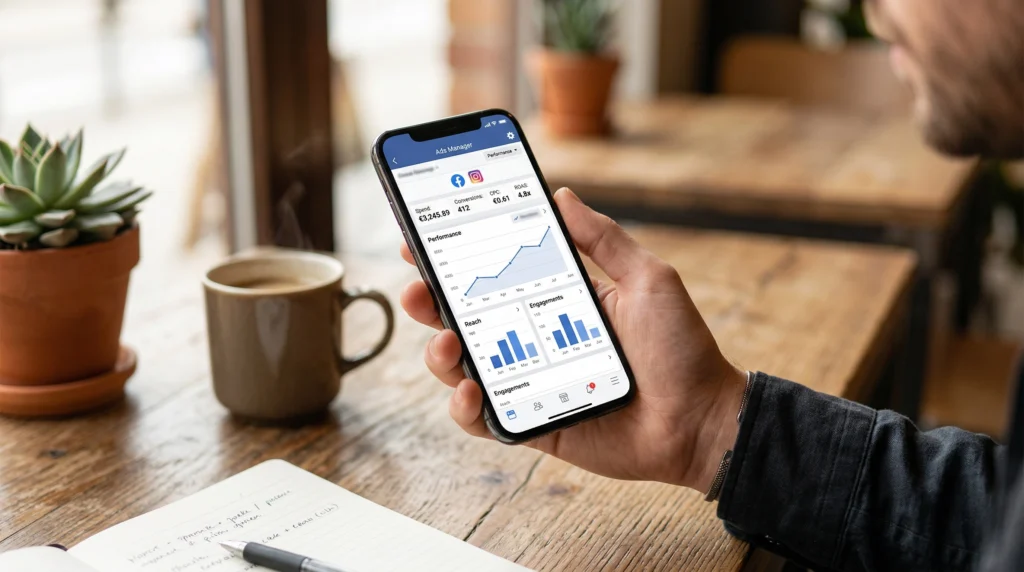
The Meta Ads panel has hundreds of metrics. These are the ones that really matter for a local business:
CPM (cost per thousand impressions) — How much does it cost for a thousand people to see your ad? A high CPM can indicate that your audience is too competitive or that your creative has low relevance.
CTR (click-through rate) — the percentage of people who see the advert and click on it. A CTR above 1.5% is good for the Costa del Sol. If it’s below 0.8%, you need to review the creative or the copy.
CPC (cost per click) — how much you pay per click. In local sectors like ours, a CPC between €0.40 and €1.20 is reasonable depending on the sector.
Cost per lead — the most important for service businesses. How much it costs you to acquire an interested contact. It varies greatly by sector: in restaurants it can be €3-8, in clinics €15-30, in real estate €40-80.
ROAS (Return on Advertising Spend) – for businesses with direct online sales. How much you earn for every euro invested in advertising. A ROAS of 3 or higher is considered profitable.
If you're not measuring these metrics, you don't know if your campaigns are working — even if you feel like «there's more activity».
Would you like to know how much you could invest in ads and what return to expect for your business? Let's talk on flavouragency.es