
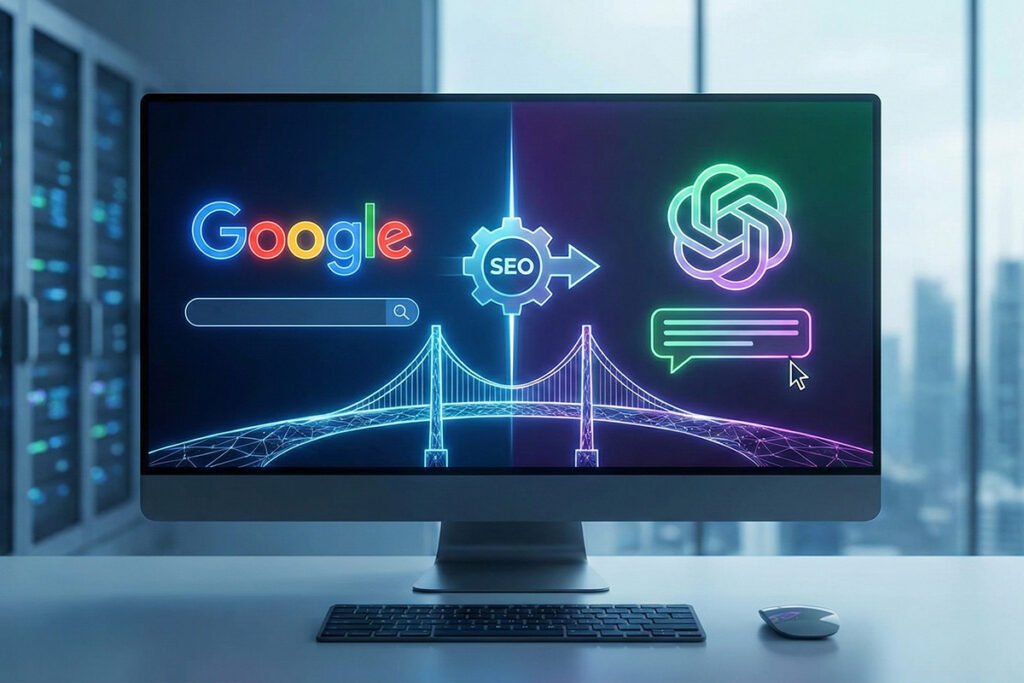
For years, SEO revolved around a single question: how to appear on Google? But since the arrival of ChatGPT with integrated search functions, the landscape has started to change. More and more users are asking questions directly to models like ChatGPT, expecting clear answers, without ads or the need to click.
This raises a key question for brands and agencies: How does this affect web positioning?
ChatGPT is no longer just a chatbot: it's an alternative search engine
With its updated version, ChatGPT can access real-time information, cite sources, and give structured answers, becoming a new channel for content discovery. Users who previously searched for «best SEO strategy 2024» on Google, now ask the same question on ChatGPT and receive a direct answer, based on hundreds of sources.
Does this mean SEO is dead? No. But it has changed
Traditional SEO remains crucial, but a new front has now come into play: the Conversational SEO. It's no longer just about ranking on Google, but about:
- To be cited by tools like ChatGPT.
- Create content that answers questions naturally and in detail.
- To have real authority, as models prioritise trusted sources.
Tips for adapting your SEO strategy to the ChatGPT era
1. Answer frequently asked questions clearly
Models like ChatGPT value content that directly answers a user's questions. Think of your blog as a knowledge base, not just a sales channel.
Use natural language, not just keywords
Conversational SEO rewards texts that sound human, are informative, and structured. Optimise for real readers, not just for bots.
3. Cite sources and offer verifiable data
Systems like ChatGPT tend to rely on sites that back up their information. Include data, sources, and structure your content professionally.
4. Go for long, well-structured content
AI model responses are fuelled by extensive, hierarchical, and in-depth content. Articles of 1,000+ words with H2, H3, and good semantics have an advantage.
Benefits of optimising for conversational search
- You attract users from new platforms.
- You reinforce your authority as an expert source.
- It also improves your Google ranking.
- You're getting ahead of a trend that's constantly growing.
Conclusion: SEO doesn't die, it evolves
ChatGPT doesn't replace Google, but it complements it and challenges it. Brands that understand this transition and create content designed for humans (and conversational machines) will have a real advantage in the new digital ecosystem.
Do you want to adapt your content to the new era of SEO?
In our agency we help businesses and professionals to Create content that ranks well on both Google and ChatGPT. Let's talk, and transform your digital strategy for what's to come.