
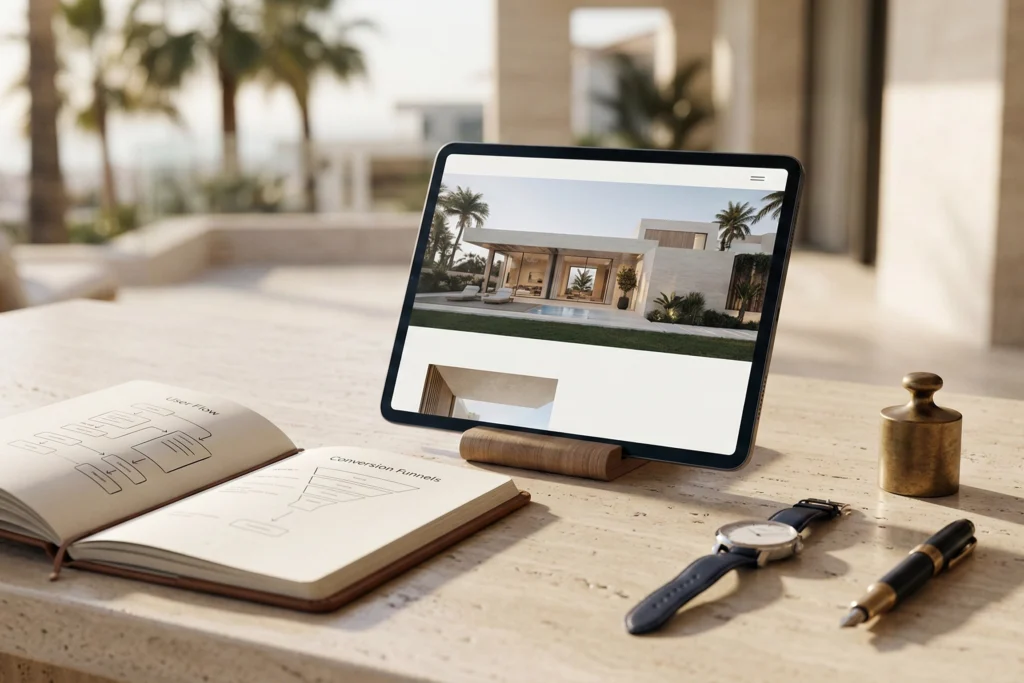
For years, having a visually appealing website seemed sufficient. Good design, modern colours, and some animation gave the feeling of being «up to date». However, in today's digital context – and especially in competitive markets like Marbella – A nice website no longer guarantees results.
Today, websites are not judged on aesthetics alone, but on what they transmit, how they work and what they make the user feel.
Design without strategy doesn't convert
A website can be visually flawless and, despite that:
- Do not generate contacts
- Not inspiring confidence
- Not to differentiate from the competition
- Not appearing on Google
The problem isn't the design, but the lack of strategy behind the design. An effective website isn't just built to look good, but to achieve a clear objective: to capture, convince, and convert.
The user decides in seconds
Users don't scan a website in depth. They skim it. In a few seconds, they decide whether:
- They trust the business
- Do they understand what is on offer
- Come with professionalism
- It's worth getting in touch
If the website doesn't quickly answer these questions, the user will leave. It doesn't matter how pretty it is.
An effective website combines form and function
In today's digital environment, a professional website must integrate:
- Clear and direct message
- Structure designed for the user
- Speed and performance
- Full mobile adaptation
- Content that generates security
- Brand-aligned design
When these elements work together, the web stops being a shop window and becomes a Active business tool.
Google doesn't look for pretty websites either
From an SEO perspective, design alone doesn't rank. Google prioritises websites that:
- They charge quickly
- They are well structured
- They offer useful content
- They generate a good user experience
An aesthetically pleasing but slow, confusing, or poorly structured website will struggle to rank, no matter how visually appealing it is.
The difference between a decorative website and a strategic website
A decorative website focuses on visual impact. A strategic website focuses on the user and the business.
The second
- Filter customers better
- Increase contact intention
- Strengthen brand perception
- Support marketing and SEO
And, above all, works for the business 24 hours a day.
Conclusion
Today, a good-looking website is just the starting point. What really makes a difference is a website designed with strategy, user-oriented, and aligned with business objectives.
In an increasingly competitive digital marketplace, The web must do more than just look good: it must work.