
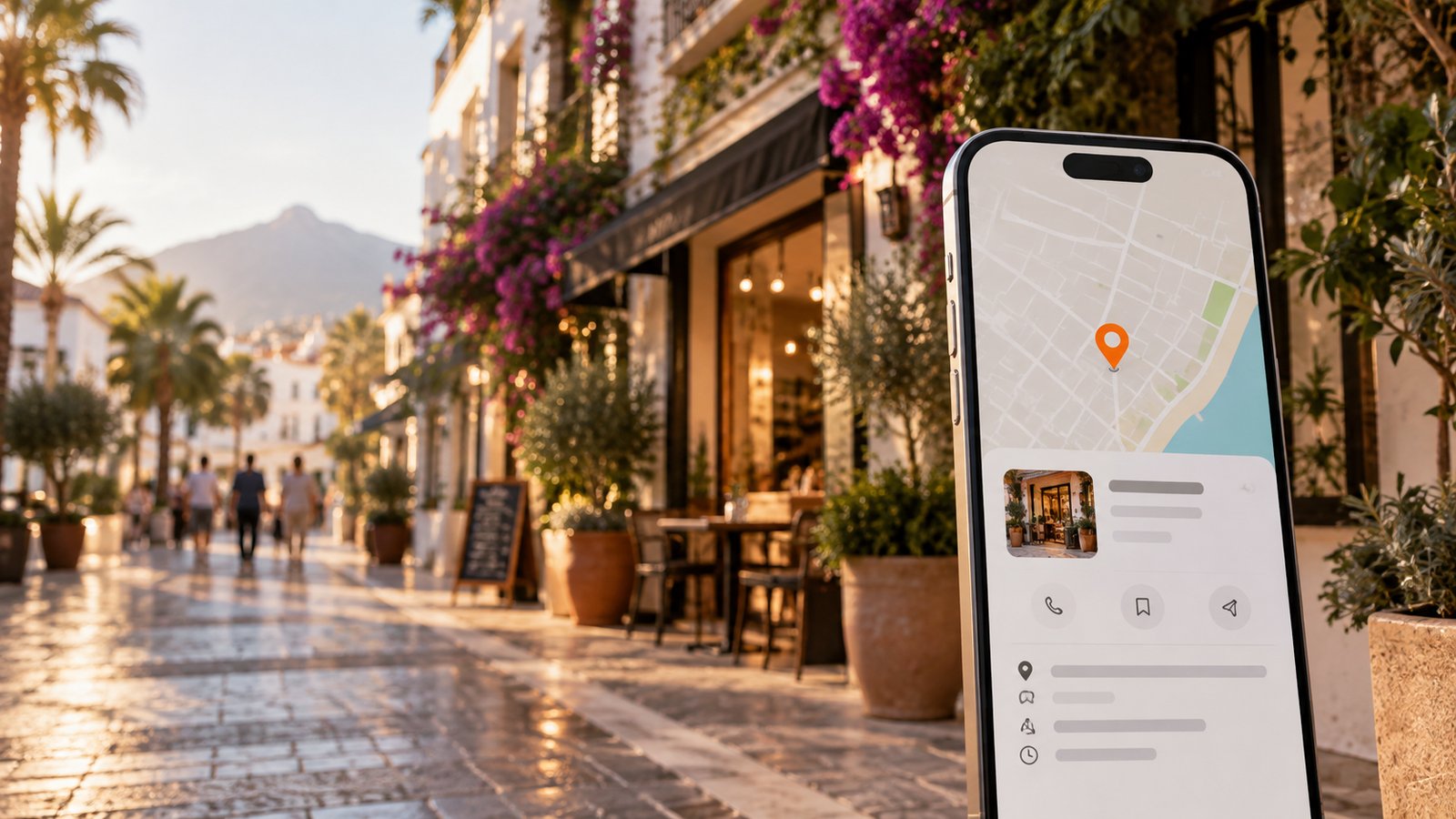
For many local searches, the tab appears before the website. There, the user decides whether to call, request directions, compare reviews, or continue searching. Optimizing it doesn’t involve filling out fields: it involves clearly demonstrating what you do, where you do it, and why people should choose you.
01
Start with the searches that generate business
Before tapping the tab, he lists the queries with real intent: service, location, category, urgency, and brand searches. Then he checks what Google shows from different areas of Marbella and what competitors appear in the map block.
Do not confuse visibility with opportunity. A search can have more volume and attract people who would never buy. Prioritize queries related to profitable services, service radius, and operational capacity.
Keep the starting point: categories, approximate position, calls, clicks, route requests, reviews, and landing pages. Without that initial snapshot, it will be difficult to know what change led to an improvement.
EXAMPLE
A clinic should not optimize the entire profile around “Salud Marbella”. It should separate treatments, urgency, language, and area, and decide which service deserves the main category and a dedicated page.
02
It configures the information that conditions everything.
Choose the main category based on the activity that best represents the business and that you want to turn into demand, not based on an aspirational description. Add secondary categories only when they correspond to services that you actually provide.
Name, address, phone number, hours of operation, and website must be accurate and match reality. Do not add services or locations to the name if they are not part of the brand used publicly.
Check special schedules before holidays and peak seasons. In Marbella, where many businesses change their hours between winter and summer, an outdated listing can lose a visitor even though it still appears in the top spot.
03
Turn the form into a useful response
Complete services, descriptions, attributes, reservations, and products when appropriate. Use the language the customer uses, but without repeating keywords artificially. Each section should reduce a doubt before calling or visiting.
Upload your own photos that explain the facade, access, space, equipment, product, and experience. A beautiful photograph inspires; a well-chosen sequence also helps to recognize the location, anticipate the service, and make a decision.
Avoid mixing old images, photo banks, and materials with contradictory styles. The flyer is a brand touchpoint: it should convey the same level of quality as the website and the physical experience.
04
Turn reviews into a reputation system
Request a review at the time of a complete experience: delivery, checkout, visit, reservation, or satisfactory resolution. Provide a direct link and explain that an honest review helps the business; don’t only select those who promise five stars.
Design the process so the team can repeat it without improvisation: who requests it, when, why via which channel, and how it is recorded. A spike in reviews followed by months of silence seems less natural than a cadence linked to the actual volume of customers.
Respond in a human, specific, and useful way. When faced with criticism, confirm facts before responding, avoid discussing personal details, and explain the resolution path. The response is not only directed at the author: the next customers will also read it.
05
What influences appearing on the map
Google primarily interprets the relationship with the search, proximity, and notoriety of the business. You can’t control where each user is located, but you can accurately describe your services, maintain a consistent presence, and build a verifiable reputation.
The linked website must support the link. If the category talks about a service that hardly appears on the landing page, both signals lose their strength.
06
Connect the tab with a page that confirms the choice
Sending all the details and services to a generic homepage wastes context. The linked page should explain the activity, the location served, the process, the available test, and an action consistent with the search intent.
It includes consistent contact information, verifiable testimonials or case studies, and responses to local objections. If you serve multiple areas, create separate pages only when you can provide specific information and expertise; changing the name of the city in cloned texts does not build a solid local presence.
Label the link with UTM parameters to identify in analytics the visits coming from the form. Also check that important calls, forms, bookings, and clicks are recorded.
07
Useful activity, not publications out of obligation
The updates can communicate services, seasons, events, or recent content. They do not replace a complete profile or a good reputation, but they help keep information up to date and offer new paths to the website.
Questions and answers also resolve frequent objections. Answer them clearly and periodically review the information suggested by users.
08
Errors that can slow down or endanger the file
Creating duplicate listings, using unstaffed virtual offices, adding keywords to the name, or choosing categories that don't belong can result in changes, loss of visibility, or suspension. Before opening another location, check that it complies with the guidelines and that it actually operates there.
Do not make major changes without saving the previous information. If a suspension occurs, document evidence of the business and fix the cause before requesting a review; sending repeated appeals without resolving the problem often prolongs the process.
The fiche also does not replace the website. If all the information and conversion depend on an external platform, the business loses control over content, measurement, and the relationship with the customer.
09
A monthly routine that prevents the file from deteriorating
Every week it reviews suggested changes, questions, messages, reviews, and critical data. Every month it checks categories, services, images, links, schedules, competition, and inquiries that are starting to generate visibility.
Do not change several important elements at once without documenting them. Note the date, hypothesis, and expected result. Local SEO improves through accumulation and learning, not through a succession of impossible to attribute tweaks.
Coordinate the information with operations: new photographs, changes in the letter, treatments, services, seasons and closures must reach the digital manager before they become outdated information.
IN PRACTICE
Weekly: reviews, questions and suggested changes
Monthly: categories, inquiries, conversions and competition
Quarterly: landing page, content, and local strategy
10
Measures visibility, actions, and sales separately
Review queries, calls, clicks, reservations, and route requests. Visualizations explain exposure; actions indicate intent; qualified contacts and sales show commercial impact.
Compare equivalent periods and consider seasonality, location, and operational changes. In Marbella, comparing August with November without context can lead to erroneous conclusions.
Close the loop by asking and recording how each opportunity came about. If a call ends outside of the CRM or on your schedule, the record will appear to generate less business than it actually does, and you won’t be able to properly value the work.
11
Checklist before starting
CHECK THESE POINTS
- Main and secondary categories reviewed
- Correct name, phone number, website, and hours of operation
- Services, description and full attributes
- Real and recent photos
- Link to the website tagged with UTM
- Active system for requesting and responding to reviews
- Monthly registered record conversions
A complete profile attracts attention; a consistent, verifiable, and well-crafted profile generates trust.