
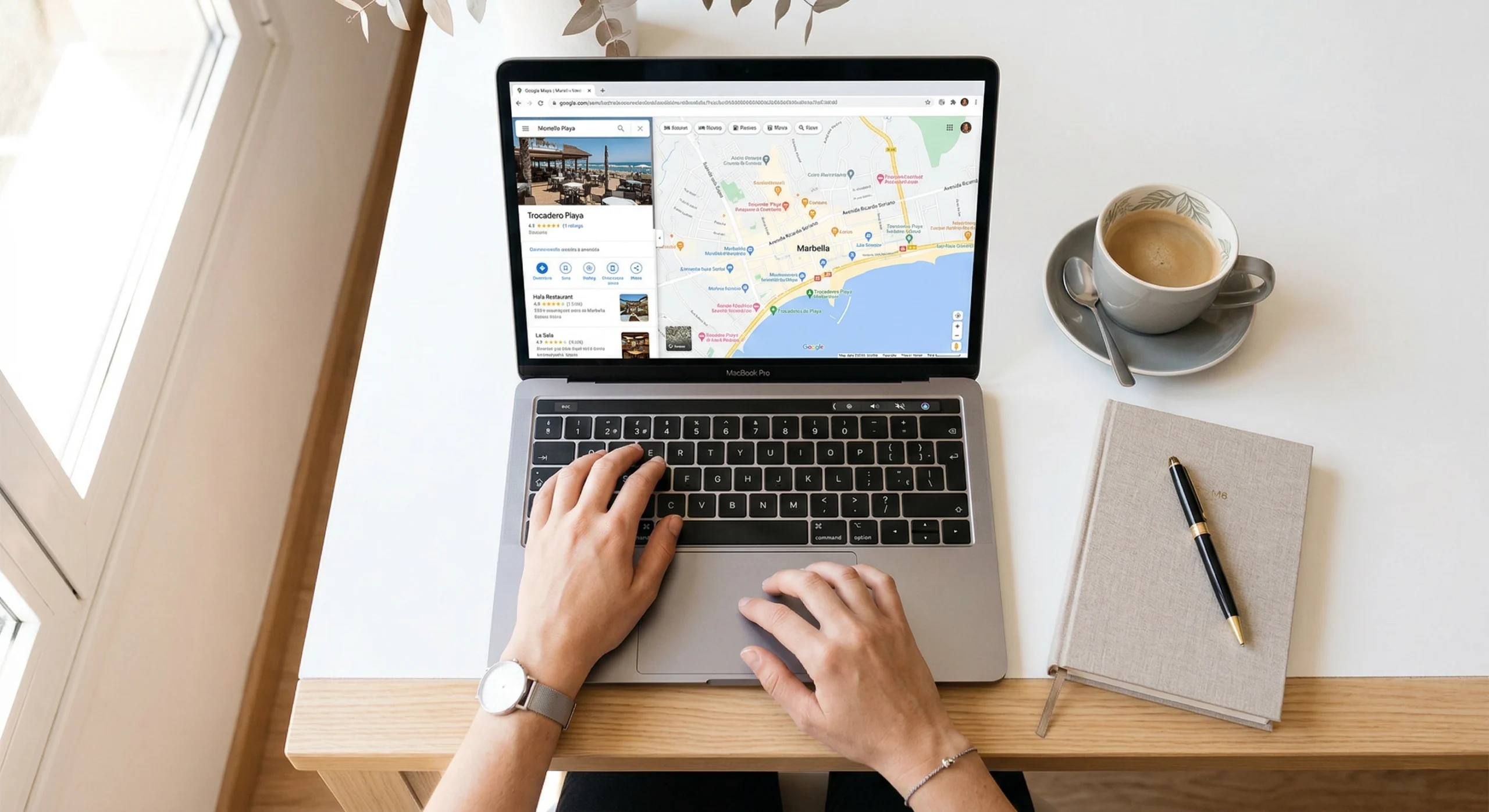
When someone searches for “lawyer in Marbella”, “real estate photographer near me” or “hair clinic Marbella”, Google tries to solve something more complex than a word match. It has to decide which businesses are relevant, are truly connected to the area, and offer enough trust signals. Local SEO is about building those signals coherently.
01
Before optimizing: understand where your business can appear
A local search can display ads, the Google Maps block—known as the local pack—and organic results. They do not compete in the exact same way. The Google listing has a decisive weight in Maps; the website and its authority support the organic results and also reinforce the local entity.
The position changes depending on the user's exact location, history, device, and query. That is why two people can search for the same thing from different parts of Marbella and see different results. Checking a single search from the office does not serve as a complete measurement.
The goal shouldn't be to “come in first” in the abstract either. Define which actions matter: calls, bookings, forms, route requests, sales, or qualified visits. Without that definition, it's easy to improve visibility without improving business.
EXAMPLE
A restaurant may prioritize Maps and immediate bookings; a B2B consulting firm may need organic pages that explain complex services. Both do local SEO, but they shouldn't follow the same plan.
02
Step 1: conduct an audit before creating content
Start by checking if Google can crawl and index important pages. Review Search Console, the sitemap, robots, canonicals, redirects, 404 errors, and whether multiple URLs are competing for the same search query. A website with foundational issues doesn't need twenty new articles; it needs order.
Next, analyze the mobile experience. Check perceived speed, visual stability, readability, buttons, forms, and ease of calling or getting directions. Local users often make decisions from their phones, and a poor experience can destroy the value of a good ranking.
Finally, I would inventory the existing signals: Google listing, reviews, mentions, important directories, service pages, projects, links, and contact information. The audit must end with priorities, assignees, and initial measurement.
IN PRACTICE
Indexing and technical errors
Current positions, queries, and pages
Google Business Profile and data consistency
Conversions and mobile experience
03
Step 2: organize keywords by intent, not by volume
A local keyword usually combines service, need, industry, or location. “SEO” is informative and very broad; “SEO agency Marbella” reveals provider and place; “local SEO price Marbella” adds a commercial consideration. The right page changes depending on the intent.
Group variants that essentially look for the same answer. “Web design Marbella” and “web design company in Marbella” can usually coexist on a single powerful page. Creating a URL for each variation fragments authority and produces duplicate content.
Add inquiries that the customer makes during the sale: price, terms, process, comparisons, requirements, and results. Their volume may be lower, but they help convert and are usually excellent H2s, FAQs, or support articles.
Intent Map
Main service → service page. Service + sector → sector landing page when there is real experience. Problem or question → blog guide. Brand or project → case study. Additional location → dedicated page only if there is a true local offer and content.
04
Step 3: Assign an SEO function to each page
The homepage must explain who you are and the overall proposal. Each main service needs its own page capable of answering what it includes, who it is for, how you work, what results it pursues, and why to trust you. The blog expands on topics; it should not replace weak commercial pages.
Success stories are especially valuable because they combine service, sector, location, and evidence. A well-documented project can capture specific searches and, at the same time, help convert users who arrived via another page.
Connect the system using descriptive internal links. An article about restaurant reservations can link to social media management, advertising, and a gastronomic case study. Those links help Google understand relationships and allow the reader to move forward without returning to the menu.
IN PRACTICE
One primary intent per URL
A single clear H1 and H2s that resolve subtopics
Links to related services and tests
No orphan pages or duplicate text
05
Step 4: create local pages that deserve to rank
A local page does not become local by adding “Marbella” to the title. It needs to explain the service within that market: types of clients, frequent problems, process, coverage, projects, testimonials, and questions relevant to the area.
Include name, address or service area, and contact methods consistently. If the business receives customers, provide a map, access details, and hours. If it operates by area, explain where it operates without inventing virtual offices.
Avoid publishing identical pages for Marbella, Estepona, Malaga, Mijas, and every single urbanisation. Only create a new URL when you can offer a significantly different answer. Otherwise, build one solid service area page and back it up with specific case studies or content.
GOOD LOCAL DIFFERENTIATION
A real estate marketing page in Marbella can talk about international buyers, shared product, and premium areas. A page for Málaga should respond to a different market and offer, not just replace the city name.
06
Step 5: treat Google Business Profile as a second home
Choose as the primary category the activity that best represents the business and add secondary ones only when they are real. Complete services, hours, phone, website, description, attributes, and booking or contact system. The name must be the true name of the company, without adding artificial keywords.
Publish your own photographs that help customers decide: facade, team, space, product, process, and results. A current and credible gallery contributes more than uploading dozens of generic images. Also review the photos added by customers.
Link the listing to the most useful page, tag the link with UTM, and keep the same essential data on the website and relevant platforms. Inconsistencies do not always cause a penalty, but they create doubts for search engines and people.
IN PRACTICE
Precise main category
Complete services and attributes
Real and current photos
Tagged URL for traffic measurement
Schedule and contact information always up to date
07
Step 6: build a reputation without manipulating reviews
Ask for the review after a satisfying experience and provide a direct link. Do not exclusively select customers you know will write five stars, do not buy reviews, and do not offer rewards conditioned on a positive rating.
An effective request is brief and explains that the detail is helpful. Instead of dictating keywords, invite the customer to share what service they received and what they valued. Specific reviews help future users more than a collection of “everything is perfect.”.
Respond to all important reviews with good judgment. In a negative one, avoid arguing in public, acknowledge what happened when appropriate, and offer a channel to resolve it. The response speaks less to the author than to everyone who will read it later.
Possible message
“Thank you for trusting us. If you have a minute, your feedback can help other people understand what the process was like. You can leave it here: [link].
08
Step 7: get mentions and links through a real connection to Marbella
The most valuable local links are usually born outside of a link building campaign: partnerships, suppliers, events, sponsorships, shared projects, media, and resources that truly deserve to be cited.
Create useful assets for the market: proprietary studies, guides, data, photography, tools, interviews, or detailed cases. Then identify who can use them and present the resource in a personalized way.
Avoid packs of hundreds of links, unrelated directories, and guest posts created solely to insert a keyword. They might inflate reports for a while without building a brand or sustainable authority.
09
Step 8: measure visibility, actions, and sales
Search Console shows queries, impressions, clicks, and pages. Google Business Profile provides listing interactions. Analytics allows studying behavior and conversions. The CRM completes the story by indicating which opportunities advanced and generated revenue.
Separate brand and non-brand terms, organic and Maps results, mobile and desktop, services and locations. Observe multi-month trends: local SEO should not be evaluated by daily fluctuation.
Create a report that answers decisions: which pages generate leads, which queries are growing, where conversion drops, what reviews or links have been gained, and what actions will be taken next. A list of rankings without context is not a strategy.
IN PRACTICE
Valid calls and forms
Reservations or route requests
Non-brand queries
Conversion by page and device
Opportunities and revenue when the CRM allows it
10
Local SEO mistakes you should avoid
Unnaturally repeating the city name, creating clone pages, renaming the listing to add keywords, publishing content without intent, and measuring only traffic are symptoms of a strategy focused on the search engine rather than the business.
It is also common to work on the business profile without improving the website, or to redesign the website and lose URLs, titles, content, and redirects that were already ranking. Any migration must start with a URL inventory and preserve or redirect every valuable asset.
Finally, do not promise guaranteed results or universal deadlines. Competition, starting point, authority, proximity, and resources change with every project. The responsible approach is to define hypotheses, priorities, and success criteria.
10
Checklist before starting
CHECK THESE POINTS
- Search Console and analytics correctly installed
- Sitemap, robots, canonicals, and redirects reviewed
- A full page for each priority service
- Verified and updated Google Business Profile
- Consistent contact information across important channels
- Continuous system for requesting and responding to reviews
- Internal linking to services, projects, and contact
- Conversions and registered lead quality
Local SEO is not won by repeating a city name. It is won by being the clearest, most demonstrable, and most useful answer for a specific need within that city.